
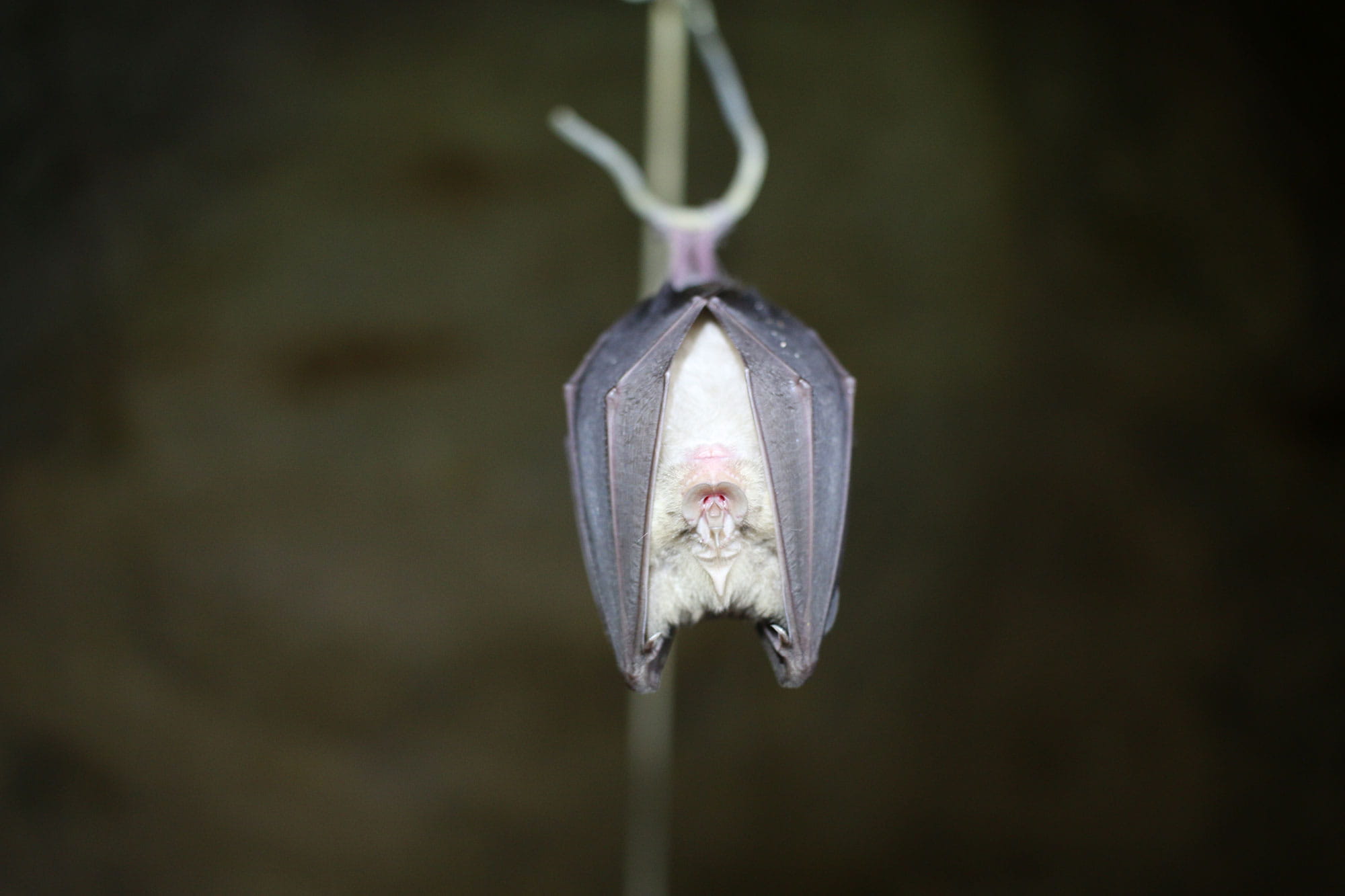
Bat Surveys
What are Bat Surveys?
Bats and their roosts are legally protected in the UK, meaning it is an offence to disturb, injure or destroy a bat or its resting place, whether bats are present at the time or not. As a result, works such as development, demolition, renovation can require bat surveys to ensure legal compliance and to avoid delays once works are underway. Bat surveys help identify whether bats are present, how they are using a site, and what measures are needed to allow works to proceed lawfully while protecting this important group of species.

Preliminary Roost Assessment (PRA)
A Preliminary Roost Assessment (PRA) is always the first stage of any bat survey or assessment. This involves a daytime inspection of buildings, structures and/or trees to assess their suitability for roosting bats and to identify any evidence of bat use, such as droppings, staining or feeding remains.
The PRA assigns each building a roosting potential of negligible, low, moderate or high, based on the quality and number of potential roosting features present.
Negligible potential buildings are considered very unlikely to support roosting bats and typically do not require further survey effort.
Low potential buildings may support occasional or transient use by bats, but nearly always in low numbers, and will often require one further dusk emergence survey to establish presence or likely absence.
Moderate potential buildings are capable of supporting a great number of bats / roosts but are still unlikely to support a roost of higher conservation status, and will typically require two dusk emergence surveys.
High potential structures are considered suitable for supporting roosts of higher conservation status, such as maternity or hibernation roosts and may require up to three dusk emergence surveys, depending on the nature of the building and proposed works.
The purpose of the PRA is to determine whether further surveys are required and, if so, what type and level of survey effort will be needed. PRA surveys can be carried out at any time of year and require access to all relevant areas of the site, including internal areas of buildings and structures, to allow a thorough assessment and early identification of any roosts where possible.

Dusk Emergence Surveys
Where a PRA identifies evidence of bats or the potential for roosting bats to be present, dusk emergence surveys will usually be recommended to establish presence or likely absence. These surveys must be undertaken during the bat activity season, typically between May and August, and require sufficient survey coverage to ensure all suitable structures are monitored.
Our team has extensive experience planning and carrying out dusk emergence surveys and uses top-of-the-line survey technology to ensure accurate and efficient data collection. This includes high-specification handheld and static bat detectors, thermal imaging cameras and infra-red video equipment supported by infra-red torches. Using this technology allows us to achieve thorough site coverage while keeping survey effort proportionate and costs under control.
The number of surveys required depends on the level of bat roosting potential identified for each building, structure or tree. Where multiple surveys are needed, they are undertaken in line with current guidance, at least three weeks apart and during suitable weather conditions.
Hibernation Surveys
Where a PRA identifies potential for hibernating bats, winter surveys may be required. These are usually carried out between November and February, with the survey approach tailored to the nature of the site and its hibernation potential. This typically involves the deployment of static detectors near or within potential roost structures over the winter period, alongside periodic inspections using torches and endoscopes where appropriate.
Bat Activity and Transect Surveys
Where a site survey identifies suitable foraging or commuting habitat for bats, activity or transect surveys may be required to better understand how bats use the site. These surveys involve walked transects undertaken at regular intervals throughout the survey season (April to October), alongside static monitoring at multiple locations for a minimum of five consecutive nights per month.
All acoustic recordings are analysed using specialist software such as Anabat Insight, allowing us to build a detailed picture of bat activity across the site and throughout the season. This information is then used to inform impact assessment, mitigation design and planning recommendations.
Why choose Whitcher Wildlife for Bat Surveys?
Whitcher Wildlife Ltd has extensive experience in all aspects of bat surveying and mitigation, and most of our team hold class licences for surveying and handling bats across England, Scotland and Wales. The survey techniques required will always depend on the site and the nature of the proposed works, and our team will advise on the most appropriate approach and design a survey methodology to suit each project. All bat surveys are carried out in line with the Bat Conservation Trust Good Practice Guidelines.
The findings of our bat surveys are presented in a clear and comprehensive report, which sets out the survey results, evaluates the potential impacts of the proposed works and provides proportionate recommendations where required.